The marketing mistakes founders keep calling strategy
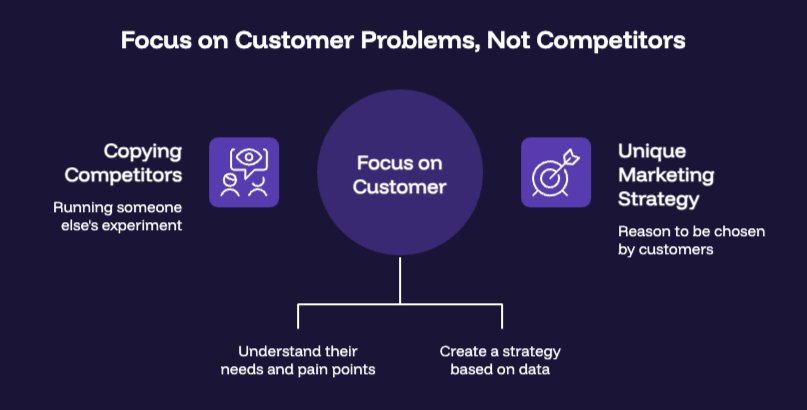
Most bad marketing is not a lack of budget.
It is a lack of nerve dressed up as pragmatism.
Founders rarely fail because they picked the wrong channel.
They fail because they made a series of comfortable decisions that each felt safe and added up to a company nobody remembers.
Here are the ones we see most often — and what they actually cost.
"Our competitor is doing it, so we should too"
A competitor's move is not a strategy.
It is a data point about their bet, made with their audience, their positioning, their timing, their trust. You have none of those things.
Copying it means running someone else's experiment with your money and calling it research.
The uncomfortable part: your competitor is probably guessing too.
When you copy them, you inherit their guess and lose the one thing that was yours — a reason to be chosen.
Great marketing starts with a customer problem, not a competitor screenshot.
Death by committee
Thirteen stakeholders leaving comments on the "final" creative do not make it better.
They make it average.
Every added voice sands down the edges, and edges are the only thing that gets remembered.
Consensus is how you produce work that offends no one and moves no one.
Someone has to own the decision.
Not the loudest opinion, not the most senior title at midnight — one owner, one point of view, accountable for the result.
Simplicity dies by a thousand small improvements.
Changing direction before anything has a chance to work
Repetition builds recognition.
Most companies kill their message right as it starts to stick, because the people running it got bored before the market did.
You are sick of your campaign around the same time customers are first noticing it.
Consistency is not the absence of new ideas.
It is the discipline to let a good one compound.
If you rebrand your message every quarter, you are not iterating — you are erasing.
Confusing attention with results
Going viral for the wrong reasons is not a win.
Reach without positioning is just noise you paid for with your reputation.
A million impressions that leave people unsure what you do, or worse, sure of the wrong thing, set you back further than silence would have.
Pick the number that matters before you chase the number that flatters.
Vanity metrics are the sugar high of marketing: fast, satisfying, and gone by morning.
Trusting opinions over evidence
"Our sister is really big on TikTok, she has thoughts."
So does everyone.
Anecdotes feel like insight because they come with confidence, but confidence is not a sample size.
The founder's gut, the board member's hunch, the agency's best practice — all untested until they meet an audience.
Test small before you scale.
A cheap experiment that tells you the truth beats an expensive campaign built on a story you wanted to believe.
Data does not care who outranks whom in the meeting.
The pattern underneath
Every one of these mistakes is the same move: outsourcing the decision.
To a competitor, to a committee, to boredom, to the algorithm, to whoever spoke last. It feels safe because no single person is on the hook.
That is exactly why it produces forgettable work.
Safe marketing is the most expensive kind.
It rarely fails loudly — it just quietly ensures no one remembers you were there. Understand your audience, hold a clear point of view, and give it long enough to matter.
Build something people remember, not something you can defend in a status meeting.