The Sampoong Playbook: Why Hiring a $50K Expert to Execute Your $5 Plan Always Collapses
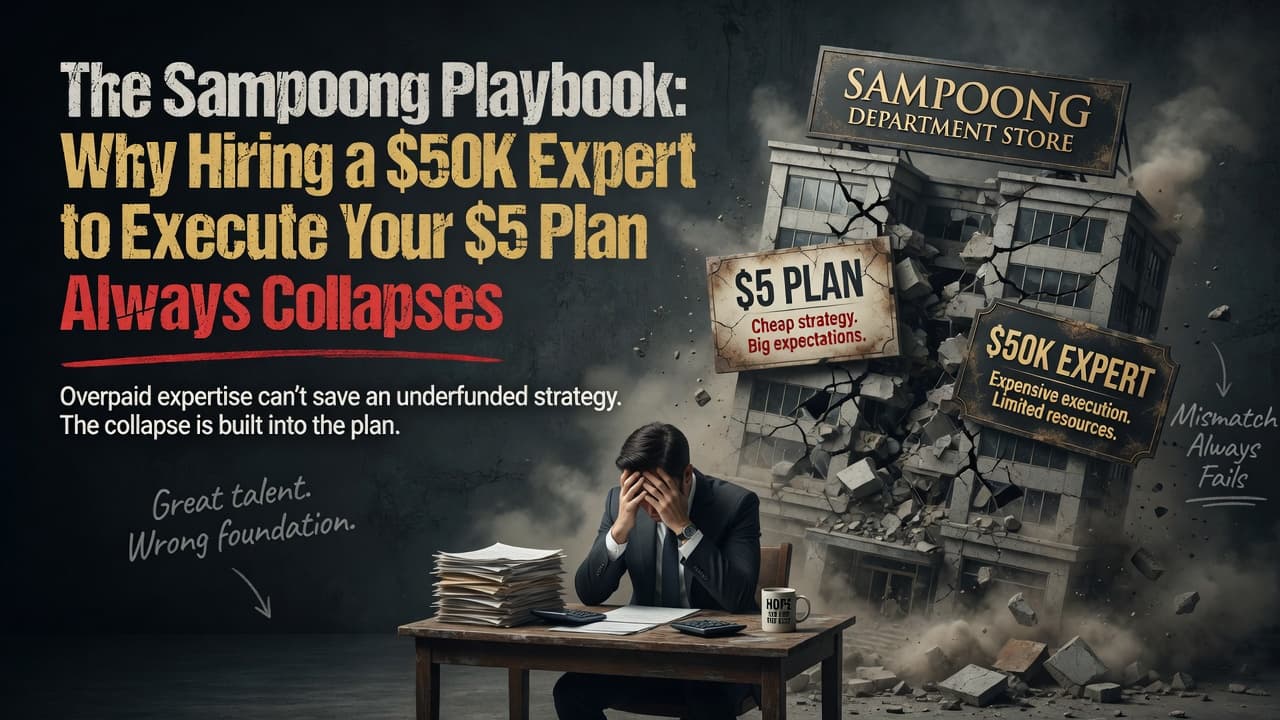
The first crack appeared in the ceiling of the fifth-floor restaurant around 10 a.m., a thin, jagged line spreading across the plaster like a crack in an old teacup. The kitchen staff noticed. They called the manager. The manager called the building operations team. And the building operations team did what they’d been trained to do: they called the chairman.
The chairman, a man named Lee Joon, had built this place against every expert’s warning. The original blueprint wasn’t even for a department store; it was a residential apartment block. But Lee Joon wanted wide, airy shopping halls. Luxury handbags don’t sell well between load-bearing walls. So he ordered the support columns removed. Structural engineers walked out. He fired them and found a crew that would do exactly what he said, safety standards be damned. They slapped a massive air-conditioning unit on the roof, added a few extra floors, and opened the doors to the public. The cracks were a feature, not a bug, as long as the registers kept ringing.
At 5:52 p.m. on June 29, 1995, the Sampoong Department Store stopped ringing. The south wing pancaked in less than twenty seconds, burying 502 people under a tomb of greed and ignored expertise.
You read a story like that and think, “What a monster.”
Then you walk into your Monday morning strategy meeting, hand your newly hired $30,000-a-month marketing advisor the playbook you scribbled on a napkin at the exec retreat, and say, “We don’t need a new blueprint. We just need you to execute this better than the last guy.”
Congratulations. You’ve just removed your first support column.
The Entrepreneur as Lee Joon
It’s easy to imagine that disasters like Sampoong are the product of cartoonish villainy, the sort of mustache-twirling evil that could never happen in a world of quarterly OKRs and Net Promoter Scores. But the mechanism is painfully familiar to anyone who’s spent a decade in B2B marketing: a founder hires a world-class expert, presents a fully baked strategy as a fait accompli, and then expresses genuine shock when the expert says, “This will kill you.”
And when the expert says it? The founder doesn’t pause. They shop. They shop for the marketing lead who won’t wince at the timeline. They find the agency that says “We love a challenge” instead of “Your audience doesn’t exist.” They collect vendors like Lee Joon collected contractors, and each one a little more willing to look at a fracture and call it a design aesthetic.
I call it The Sampoong Playbook. Step one: Hire the talent that knows how the building stands. Step two: Ignore every structural warning. Step three: Demand absolute compliance to a plan that was flawed before you even wrote the check. Step four: Wait for the collapse, which will be invisible from the street right up until the roof comes down on your pipeline.
The $1 Billion Joke That Isn’t a Joke
Recently, a dialogue from Simon Wardley's LinkedIn page made the rounds that’s so perfectly distilled I’m just going to drop it here:
X: We’re planning to spend $1 billion on building a sovereign distributed AI platform which will replace 70% of our workforce.
Me: Oh dear … that sense of deja vu.
X: What?
Me: Do you have maps of the space? Have you determined how the market is changing? What’s the purpose of the system? If you’re talking about changing work patterns do you have someone responsible for re-allocation of work? Do you know how you are going to measure this — impact on P&L, override rates etc? Have you considered replacing tasks not people? Have you looked into Jevons paradox? Are you intending to build this yourself? What do you mean by sovereign, are you including the training? So, many questions.
X: Can we hire you to help?
Me: Hang on, let us discuss those questions first.
X: This is why we need help.
Me: Ah. What if it turns out to be a bad idea?
X: The strategy has already been determined. We’ve run an early stage pilot which was a success. We just need help in bringing this to production.
Me: By success, how many people had access, how many people are still using it, how much work was replaced, what was the impact on P&L?
X: It was successfully delivered.
Me: Hmmm. Ok, I think I have enough. I can guarantee to give you the same impact for your $1 billion project for … about $25M.
X: How?
Me: Pay me $25M. I’ll sit on a beach drinking Margaritas for five years. At the end, I’ll call you up and say “we failed”. This way you save $975M.
X: That’s not very helpful.
Me: No, but in seven years time, you’ll wish you had paid me.
…
…
Me: Hello? Are you still there?
…
…
Me: Oh well.
That dialogue hits like a freight train because it’s not satire. It’s a transcript from a thousand discovery calls. The “strategy has already been determined” is the moment the floor cracks. “Successfully delivered” is the language of a team measuring structural integrity by how many escalators are still running. The founder isn’t looking for an expert; they’re looking for a prestigious construction crew to install marble countertops on a foundation that’s already crumbling.
And the punchline? The beach and the $25 million? It’s not even a joke. It’s a discounted funeral.
Why Smart People Eat Their Own Blueprints
The psychology behind this is so predictable it should be a documented mental health condition in the DSM.
First, there’s the Expert Fallacy.
“I know my business best.” Of course you do. You know your product, your vision, your late-night shower thoughts about category dominance. But knowing your business and knowing how to communicate that business to a cynical market are two different neurological events. Lee Joon knew he wanted luxury handbag space. He didn’t know how to keep a building upright. You know you want $20M in pipeline. You don’t know that your “thought leadership” podcast is generating zero signal and making your brand look desperate. The expert does. And you’re paying them, right up until you tell them to shut up and record episode 47.
Second, there’s the Validation Hire.
You don’t want a diagnosis; you want a stamp.
You’re not hiring an expert to apply a decade of hard-won pattern recognition to your problem; you’re hiring them to make your hunch look respectable in the board deck.
When they refuse, you experience it as insubordination, not as a safety warning. Then you post on LinkedIn about how “consultants just don’t get execution.”
Third, the Shiny-Object Death Spiral.
The pilot was “successfully delivered.” Not adopted. Not loved. Not revenue-generating. Delivered. As if the act of building something is the measure. When your KPI for a marketing hire is “executed my plan,” you don’t need a strategist—you need a task rabbit with a Harvard MBA and a bad case of imposter syndrome. You’ll find them. And they’ll build your cracked cathedral right on schedule.
Sampoong’s cracks were visible for hours. Employees pleaded. Shoppers complained. The leaders chose revenue over rebar. Your business shows cracks too—dead email sequences, churned customers who never activate, a pipeline report that’s really just a list of MQLs who downloaded a whitepaper in 2023 and never answered the phone. And you’re still insisting on the same open-plan marketing design because it “feels like us.”
What You Actually Paid For
Let’s reframe what a high-ticket expert is supposed to do, because the industry has lied to you. The first duty of a real expert is not execution. It’s not even strategy. It’s the painful, relationship-ruining, ego-bruising act of telling you your plan is dangerous. Their second duty is to rip up your beautiful, laminated blueprint and draw one that won’t kill the people inside.
If you are not prepared to sit in a room and hear the words, “This is actively harmful, and here’s what needs to die before we begin,” then save your retainer. You’re not hiring an architect. You’re renting a nicer shovel to dig a deeper hole.
I’ve seen this up close. You hire a demand generation lead with a track record of building pipeline machines. Day one, you hand them the same tired whitepaper syndication playbook that’s been running on fumes since 2019. They tell you, “This audience is blind to this offer; we need a different entry point and a nurturing journey that actually reflects buying intent.” You say, “Let’s just optimize the subject lines and add a retargeting pixel.” Six months later, zero pipeline. You fire the expert. The building collapses. You blame marketing.
You hire a positioning strategist. You present a “messaging house” you built in a Miro board during a retreat that involved a lot of sticky notes and very little customer data. They gently point out that your core story is a solution in search of a problem. You counter with, “But it’s who we are.” A year later, your win rate is in the single digits, and you’re moaning that the market “doesn’t get us.” No, the market understood you perfectly. You were standing on the wrong floor, and the expert tried to evacuate.
How to Stop Building Sampoong Departments
You can fix this. It’s not complicated, but it is emotionally expensive. Here’s your retrofit kit:
1. Hire for diagnosis, not delivery.
When you bring an expert in, the first deliverable isn’t a campaign calendar. It’s a red-pen critique of the current plan. You don’t get to edit it. You don’t get to spin it. You sit with it for 48 hours, you feel the sting, and then you decide if you’re willing to act on it. If you’re not, release the expert with a clean handshake and a “thank you for your candor.” It’s cheaper than a collapse.
2. Fire yourself as chief architect.
You set the vision: “We want a luxury department store.” Beautiful. Then you step away from the load-bearing walls. If the expert says the foundation needs six months of customer research and narrative work before a single ad goes live, you listen. Or you find someone else. But don’t keep the expert and override them; that’s the precise formula that buried 502 people.
3. Learn to love cracks more than smooth walls.
When a team member, a consultant, or an agency says, “Hang on, there’s a fracture here,” that isn’t a personality flaw. That’s the whole reason you pay them. Celebrate the person who points out the tiny fissure that no one else sees. They’re the only thing standing between you and a catastrophic, LinkedIn-announcement-less failure.
4. Audit every “successfully delivered” project from the last two years.
Go find the campaigns that “launched on time.” The website refresh that “everyone loved.” The AI pilot that was “delivered.” Now check: Is anyone still using it? Did pipeline move? Did a single human being change their buying behavior because of it? If not, you’re the guy in the boardroom raising a glass to a remodel while the floor beneath you is already tilting. Stop doing that.
The Call Nobody Made
On the afternoon of June 29, 1995, the restaurant manager saw the cracks widening. He called the board. The board called the chairman. The chairman considered the day’s revenue. The word came back down: keep the doors open. The emergency services were never contacted. The shoppers never knew.
Right now, some founder reading this is staring at cracks in their marketing strategy. They just paid a consultant five figures for a brutally honest audit. The recommendations are sitting in their inbox, unopened or skimmed with the vague intention to “cherry-pick what works.” Their gut tells them the expert is probably right. But the plan doesn’t feel like them. It’s too slow. Too unsexy. Too honest about the state of the market. So they’re going to thank the consultant, file the report, and hire the next person who smiles and says, “I can make your vision work.”
That founder has two choices: listen and rebuild, or keep the escalators running until the roof comes down.
Please, stop hiring people who understand how the building stands and then ordering them to hand you a sledgehammer. We have enough corpses in the pipeline graveyard. What we’re running out of is people willing to tell you the truth before the dust settles. Be the rare founder who hears it. Because the alternative isn’t a failed campaign. It’s Sampoong. And you won’t get a second collapse.